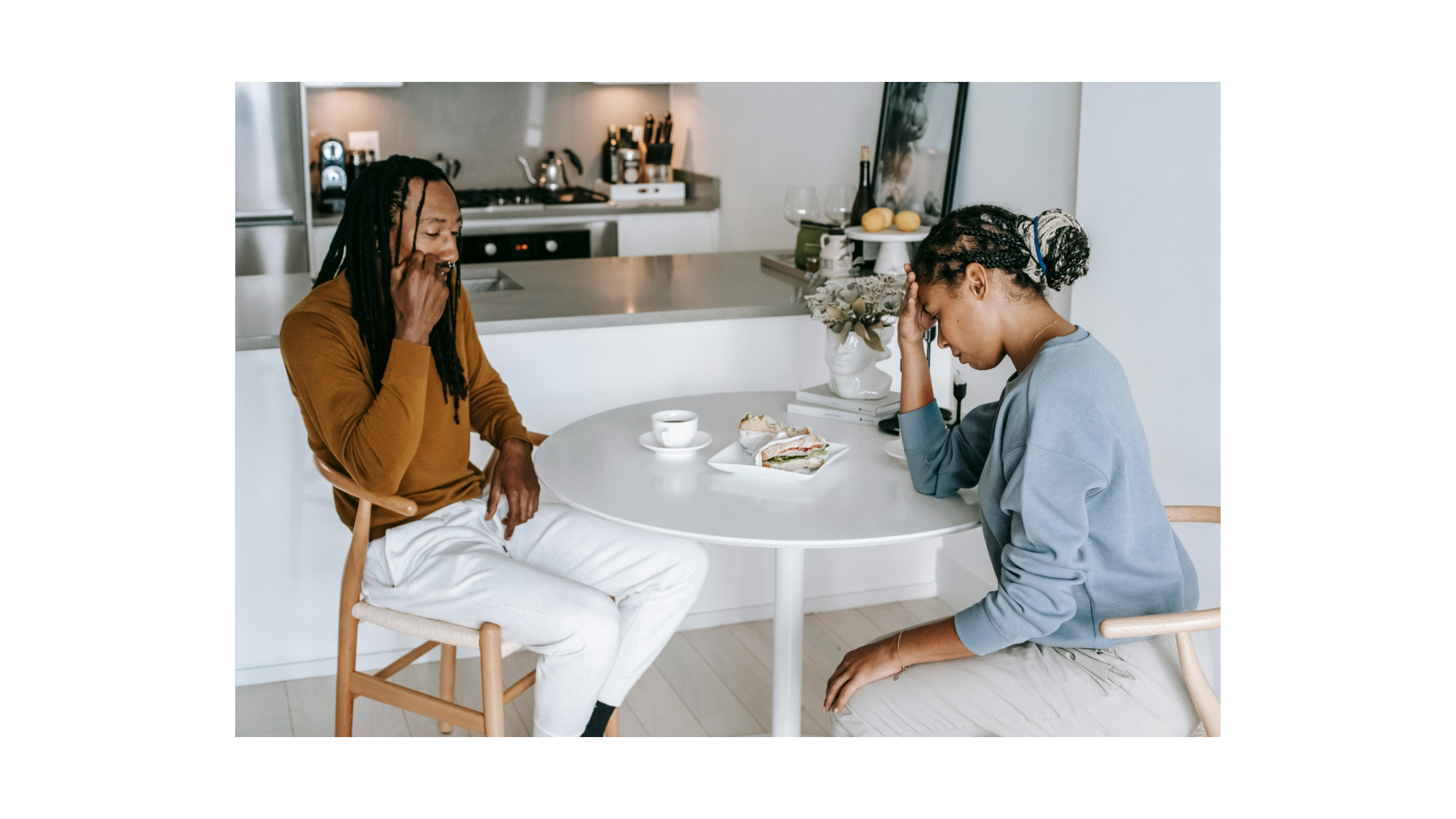
In some marriages, there are four people at the table.
Two are visible. The other two are the parents who raised them.
You can hear them in ordinary sentences, said lightly, often without any unkindness at all.
Whose voice is in the room?
- “My dad was like that with my mum, and she never complained.”
- “My mum did that every day. Why can’t you?”
- “My father never washed a plate in his life, and our home was fine.”
- “My mother would never have spoken to him like that.”
- “My dad always said a man does not apologise.”
- “My mum always said a good wife keeps quiet.”
- “In my house, we did not talk about these things.”
Each one sounds like a small remark. Together they build a standard your partner can never meet, because it belongs to a marriage they were never in.
A story: Abena and Kofi
Abena had worked a ten-hour day when Kofi looked at the kitchen and sighed.
“My mother cooked every night, after working herself, and she never once complained,” he said. He did not say it unkindly. He said it the way you might mention the weather.
Abena stood there with her coat still on. She had heard versions of that sentence for six years. My mum ironed his shirts. My mum kept the house quiet when my dad slept. My mum never made a fuss.
“Kofi,” she said quietly, “did anyone ever ask her if she wanted to?”
He opened his mouth to answer and found he had nothing to say.
The following weekend he drove to see his mother. He had not planned to raise it. But over tea, almost as a joke, he asked how she had managed it all without complaining.
She looked at him for a long moment. “Who would I have complained to?” she said. “Your father? My mother? The church? I learned to be quiet because there was no one to hear me.”
Kofi drove home in silence. That night he washed the plates without being asked. When Abena came into the kitchen, he said something he had never said before. “I think I have been measuring you against a woman who was never allowed to say she was tired. I am sorry.”
They did not solve everything that night. But something in the house eased.
This is a story we have heard before, in many forms. What changed was not the housework. It was that the standard was finally questioned.
What is really being said
Look closely at “she never complained.” It is offered as proof that everything was well. Often it means she was never allowed to. Silence is not the same as contentment, and endurance is not the same as love.
Look at “why can’t you?” The question sounds like a comparison. But it tells your partner that they are being measured against someone whose life they did not live, and whose sacrifices they were never asked to make.
And notice that this goes both ways. Wives say “my father would never have spoken to my mother like that.” Husbands say “my mother never asked for help.” Either way, one person in the marriage is being asked to live up to a memory.
Why people say it
Most people who speak this way are not trying to wound. They are defending the only script they were given. Questioning it can feel like betraying their parents, or admitting that the home they grew up in was not as safe as they needed it to be.
So the parents become the measuring stick, and the partner becomes the one who falls short.
If you are the one hearing it
- Name it calmly. “I notice you compare me to your mother. It makes me feel I can never be enough.”
- Ask what sits underneath. “What did that look like in your home, and what did you need from it?”
- Remind them you are building something new. “I love that your parents made it work. We are allowed to make it work in our own way.”
- Choose your moment. Not mid-argument, and not in front of family. Quietly, when you are both rested, works far better.
- Do not carry it alone. If the comparisons are constant, or come with contempt, a counsellor can hold the conversation with you.
If you are the one saying it
- Listen for your parents’ voice in your mouth. When you hear “my dad” or “my mum” in a complaint, pause and ask, “Is this what I need, or what I was taught to expect?”
- Ask if the standard was ever fair. Someone in that marriage may have been carrying more than anyone saw.
- Speak from your own need. “I would love more help in the evenings” lands very differently from “my dad never had to ask.”
- Ask your parents honest questions. Like Kofi, you may find the marriage you admired was more complicated than it looked.
- Apologise plainly when you catch it. “I compared you to my mum, and that was not fair. I am sorry.”
When it is more than a comparison
Sometimes these sentences are not just habit. If the comparisons come with belittling, control, threats or fear, that is no longer a difference of upbringing. That is a pattern worth taking seriously. Please speak to someone you trust, or reach out to a domestic abuse service. You do not need to wait until it feels bad enough.
A closing thought
Your parents’ marriage is part of your story. It taught you a great deal, some of it good, some of it painful. But it does not have to be your partner’s rulebook.
The marriage you are building deserves its own standards, its own language and its own kindness.
If this has stirred something in you, please do not sit alone with it. Reach out, speak to someone you trust, or book a conversation with me at shereallyheals.com.
You are allowed to build something new.
With love,
Anita